Pro 1SEO

AdSense

Protect Your files - IObit Protected Folder 1.2 Serial Key Free Download

IObit Protected Folder 1.2 Serial Key Free Download

IObit Protected Folder 1.2 Serial Key Free Download

IObit Protected Folder 1.2 Serial Key Free Download
Iobit Protected Folder is used to protect your folders and files with master password. It is so easy to use just drag and drop the folders or files you want to hide or protect into Protected Folder, then no one can see, read or modify them. You can secure your privacy by using this amazing software to protect your important and personal files. It is easy to manage. You can lock and unlock important office documents, photos, videos, and other items in any format and any amount at the same time.

Iobit Protected Folder 1.2 Key Features

  • No Worries of Data Theft
  • One Password Protection Solution
  • No Worries of Privacy Leaks
  • Easily block access to files, folders, and programs you choose.
  • Hide folders, files, pictures & videos

How to Activate Iobit Protected Folder 1.2?

  • Download and install IObit Protected Folder 1.2(2.9MB).
  • Open IObit Protected Folder (you have to TURN OFF YOUR INTERNET CONNECTION).
  • Copy one of the keys given below and activate IObit Protected Folder.
  • It will give a license validation error, just ignore it and press okay.
  • Close IObit Protected Folder and Turn on your internet connection (if you want).
  • Open IObit Protected Folder again enjoy lifetime pro license.

IObit Protected Folder Serial Keys

  • DA71B-8016B-A2C74-F54B9
  • 3EA3C-91523-FB551-905B9
  • F8032-E21FB-61D73-BABB9
  • A54C4-E7FBB-AB9E5-E7EB1

اسهل طريقة تصنعين بها ( مرقه الدجاج الفوربه ) فى البيت بنفسك !! ..


  اسهل طريقة تصنعين بها ( مرقه الدجاج الفوربه ) فى البيت بنفسك !! ..


نظفي دجاجة جيداً أو لحم حسب رغبتك, ثم أسلقيه وخذي خلاصة السلق (المرق) ضعي شوية زيت بالقدر ثم ضعي عليه دقيق, ثم بهارات حسب ذوقك وخصوصاً فلفل وملح وكمون يمكنك اضافه ملعقه صغيره سكر ( هذا هو ما يعطيها المذاق الحلو ) ثم تخلط جميعها وتوضع على النار وصبي عليه المرق بالتدريج وأنتي تحركين إلى أن تصبح مثل عجينة الكيك.. ثم صبيها في قالب مكعبات الثلج الصغيرة بعد أن تضعي ورقة الزبدة في الفراغات وضعيها في الثلاجة إلى أن تتماسك وغلفي القوالب وخليها في الثلاجة .. ومتى ما احتجتيها خذي من نفس القوالب.. وبعد كل فترة وفترة سوي اللي يكفيك شهر ..

Find Keywords


Step 1. Start with a common word or phrase that is appropriate to your business

Start simple. Your starting point does not need to be clever or creative. All you need is a common word or short phrase relevant to your business - Wordtracker will help you find cleverer keywords later.
Suppose you sell chocolate online. A good starting point for your business would be the word chocolate
Using Wordtracker's Keywords tool, you can find thousands of keywords that all contain the word chocolate.
It couldn’t be easier to start your keyword research - just click the ‘Quick research’ tab and get going!
You can just enter a single seed keyword (as we said, if you’re researching chocolate, use chocolate).
In a few seconds you’ll see up to 10,000 keywords (depending on your subscription level) containing the word ‘chocolate’ appear in your list, sorted in order of popularity, or Search Volume. There are several things you can do with this list, but let’s start by talking about the numbers you’ll see.

Search Volume

This is the number of times each keyword has been searched in the Wordtracker database (Wordtracker’s data comes from a major search engine advertising network which passes us, on average, 3.5 billion worldwide searches per month. They deliver traffic from hundreds of niche web properties, search engines and portals. The data is from the last calendar month. These are real searches made by real people).
If you’re new to keyword research, look for relatively high volumes. A high number (against other keywords in the same list) means that lots of people are searching using that keyword.
These figures are not meant to be used as an exact number of searches, or a prediction. It’s best to think of this figure (and all the other numbers you see in the tools) as a relative value. Don't worry too much about the numbers themselves. Instead, consider the relationship between the keywords: it’s easier and more helpful to see that chocolate is searched more times than healthy chocolate than it is to try to work out exactly how many people will search for each term in the next day or week.

Competition

The competition number gives us an idea of how many web pages already exist that have been optimized for each keyword. A high number is bad, as it means lots of websites will be competing with you.
The competition figures are on a scale from 0-100. A figure of 100 means lots of competition, so it will be difficult to rank on the first page of Google’s results for that keyword.
If you’re new to keyword research, just remember: high competition figures are bad.

IAAT

IAAT stands for 'In Anchor And Title'. This figure tells us how many pages have been directly optimized for each keyword by having the keyword both in the title tag and also in anchor text in a link from an external domain (somebody else's website). It's a good measure of how much direct competition exists for a keyword, and can help inform your choices. The Competition figure above is based on IAAT.

KEI - Keyword Effectiveness Index

KEI is one of the quickest ways to find keywords with good potential - that is, those keywords which are likely to help your site attract more traffic. It looks like this:
It's a scaled metric, so you'll never see a KEI of more than 100. That doesn't mean that we can go back to the old method of thinking that a KEI of X or Y is good, or that a KEI of Z is bad - it's still important to look at the numbers as relative values inside a niche - what might be a good KEI for one niche may prove not to be so useful inside another niche - so do look at the relationships between the figures in this column rather than just relying on pure numbers.
So how do we use KEI? Simple! There are two ways that we can find helpful figures - we're looking for a high KEI as these are the keywords that show potential. The first thing to do is to sort the column by KEI just by clicking the column header. We can see the highest ones at the top of the list instantly, so look for the keywords that are relevant to your business.
The second way you can narrow down your list according to KEI (if you're familiar with the market you're targeting and have a rough idea around search behaviour in that niche) is to use the filters on the right to exclude keywords with a KEI below a certain figure - you'll probably get more of a feel of what to exclude the more you work with a niche.

How do we find keywords with potential?

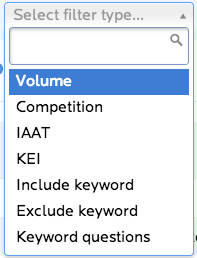
Often, you'll find thousands of relevant keywords. You can't necessarily target all of them, but you can use the filters (at the top of the Keyword results table) to narrow down your keyword list:
You can include or exclude keywords that contain certain words (so if you’re looking at a list for chocolate, you can show (or hide) all the keywords that also contain truffles.
It’s easy to filter out keywords with high competition (high competition is bad) or low search volume (bad again, a low search volume means the keyword gets little search traffic).
If you’re new to keyword research, use the filters to look for keywords that are popular (high search volume) and have little competition (low competition figure). You can filter by KEI as well as IAAT, or just by keywords containing (or not containing) certain words.

Content ideas

Struggling for content ideas? Then you’re not alone. Lots of people find it difficult to know what to write about.
The Wordtracker Keywords tool can give you great ideas for creating content. Your site visitors are likely to have a ton of questions about all sorts of things. They want answers and many of them will go to a search engine to find them. When they do so, they often enter their entire question in the search box and hope to find a quick answer. By providing the answers to their questions, you’ll create interesting copy and pick up a lot of relevant traffic for your website.
You can tap into these questions in your market - just choose the the Keyword Questions filter and hit 'Apply'...
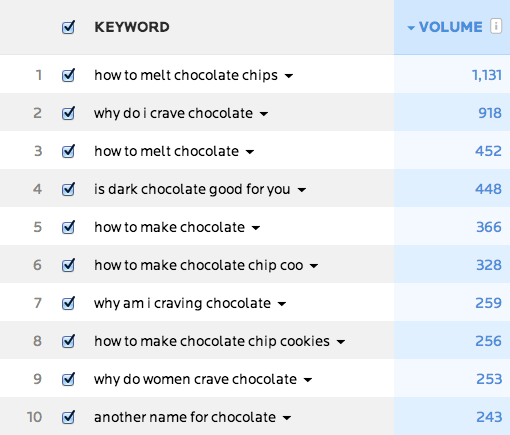
...and the Keywords tool will generate content ideas by showing you the questions people are asking in your industry.
Now go through the results and pick out the questions that are important to your business and use them to create content. Once you’ve got your list of relevant questions, you can either create a blog post for each question or group the questions and answer several in one piece of content.
In doing so, use the question as the main title in your content and decide on a secondary keyword that you might also use.
So if, I decide to write an article on ‘how to make chocolate’, I might decide that my secondary keyword is ‘chocolate recipes’ - so I would make sure that my article also mentioned ‘chocolate recipes’.
With the keyword questions tool, you don’t have to worry too much about what the numbers mean. All you really need to know is that people are asking those questions online – and then provide the answer for them, but don’t just stop at ‘chocolate’ - try using the Keyword Questions filter on your other lists, and you’ll soon have a host of great content ideas.

Multiple filters

It’s not easy to identify the best keywords for your site when you’re choosing from lists of thousands.
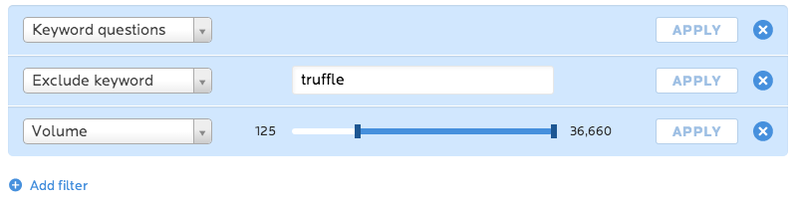
You can use multiple filters to refine your lists, like this:
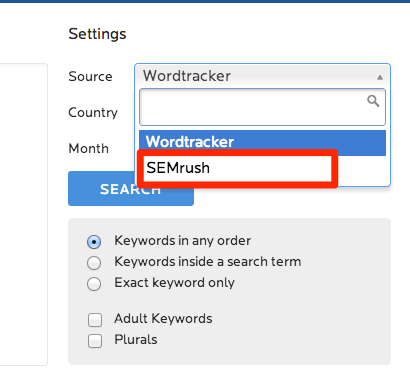
Of course, you might want to get a second opinion on your niche. We’ve made this easy for you to do. Just choose the SEMrush option next to the seed word box:
You’ll see your original seed keyword in the box on the left. Just click ‘Search’ and you can see all of SEMrush's suggestions and Search Volume estimates. Don't expect to see the same results as you saw in the Wordtracker numbers. Each list is likely to report its own distinct keywords, and there are likely to be great suggestions in each.
Any filters you set up are also remembered.

Exporting Keywords:

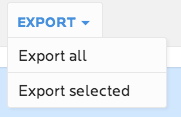
This is a simple task - just hit the 'Export' button, and you'll be able to download a csv file of all the keywords on the page (or just some that you've selected) so you can share or manipulate the data as you please.

So to recap quickly ...

We’ve shown how you can:
  • Build a keyword niche on the ‘Quick research’ page using either Wordtracker or Google data.
  • Filter each list to find terms with high volume and low competition
  • Export your data so you can share it with colleagues or clients.
If you're new to keyword research, it's worth taking some time to familiarize yourself with the tool before moving on. If you've questions, please let us know at the bottom of this page.
If you’ve got to grips with the tool, we'll move on to the next stage of working with keywords. We’re going to look at how to use the Keywords tool to manage our keywords in an organized way.
Wordtracker’s Keyword research tool works in Projects and lists. Here's how to set those up:

Step 2. Setting up a Project - organize your work

Google loves clear, logical site structure and the Keywords tool can help you create one. You should start by setting up a project for the website you're working on.
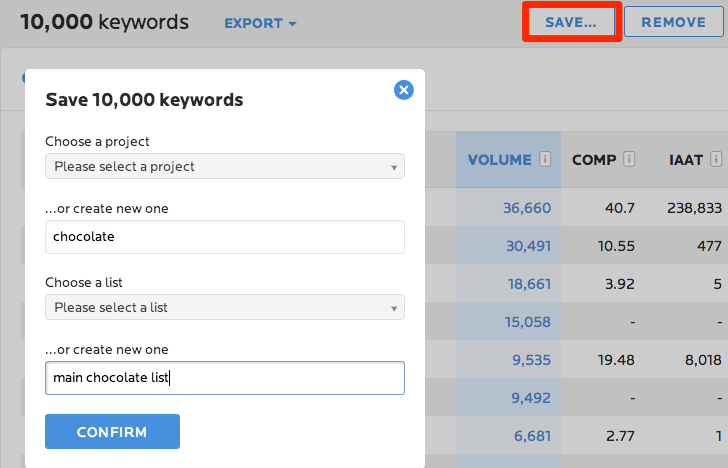
This couldn’t be easier - just make a relevant search, and then hit the 'save' button. You'll see a window open here, and you're ready to save all of the keywords in the list that are selected (all the keywords are selected when they're shown to you by default).
  • Give your project a name
  • Add a list name
  • that's it!
Your Project can hold all the work you do for a single website. The work is broken down into lists. Starting a Project is really straightforward - you can do it with a single keyword (you’ll be amazed how quickly this can grow).

Adding Keywords

You can add keywords to an existing project or list just by selecting them in the window when you've pressed the 'save' button.
You know more about your business than anyone else, so it’s likely you can think of relevant keywords that you’d like to investigate. You can easily paste in your own keywords (up to 500) to the tool - just paste them into the seed word box, and choose 'Exact Keyword Only' in the search options - we'll give you data for every one of those keywords that's in our database.
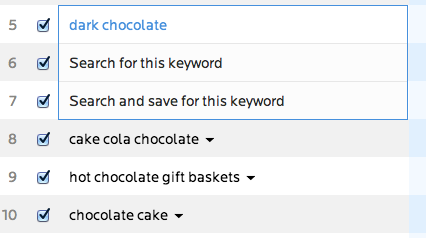
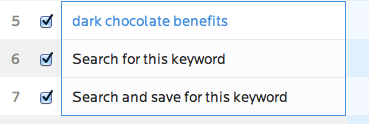
Another incredibly quick way to build up groups of keywords that are relevant to your work is to use the 'search and save' function. You'll see this when you click on the little triangle next to each keyword:

Click 'Search for this keyword, and a fresh search on that keyword (with your previous settings) will be run on the page. Select 'Search and save for this keyword', then the search will be run and saved (once you've chosen a Project and list to save to) and you can carry on building your lists up - each list could contain keywords to optimize one or more pages.

Reviewing your Project:

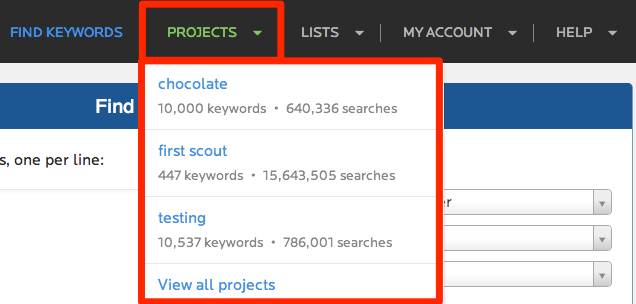
Head to the 'Projects' link at the top of the page, and you'll see the last three projects you worked on, and a link to an 'all Projects' page:
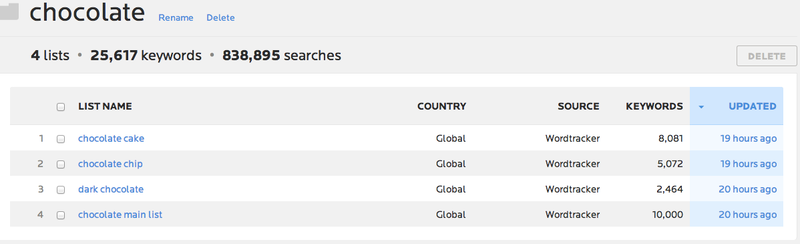
Head to the Project you want to work with, and it'll appear on the page (I've just added a very few lists here to give you an idea, but there are no limits to the amount of lists you can save in a project). 
Google loves well organized websites, and so will your users. If your site architecture and internal linking make sense, it will be easier for search engines to find and index your pages and, more importantly, for your visitors to navigate through your site.
As we mentioned, the Keyword research tool helps you create a clear site structure with the minimum of effort. Let's say you've a category page on your site that's dedicated to selling dark chocolate. You'd like to add more pages and are looking for relevant long tail keywords you can target.
When you find a keyword you want to work with (dark chocolate), you can create new lists really easily. The screenshot below is from a list based on 'dark chocolate'. Again, you can use 'Search & Save' to build up further lists based on the keywords in that list.
Now all you have to do is rush off and optimize your web pages for those phrases, right? Wrong! That is what most people will do and as a result, they will miss out on some very powerful keywords that are not immediately obvious. There’s more work to do - let’s take a look ...

Step 3. Find words that are related to your original keyword

Successful sites will attract traffic from many thousands - often millions - of keywords. So, it's a good idea to broaden your research and look for keywords you might not immediately think of.
Let's take our chocolate example. Our task is not to find keywords that contain the word chocolate. In fact, it's just the opposite - we want to find relevant keywords that don’t contain the word chocolate.
The reason for this is to extend your thinking about how you optimize your pages, and the content you create. After all, if you're only targeting chocolate you're missing the opportunities presented by truffles, hot fudge, and candy. The Related Keywords tool can help you find hundreds of keywords that you’ve not thought about that could bring more traffic and business to your site. It will help you unearth whole niches you would otherwise miss.
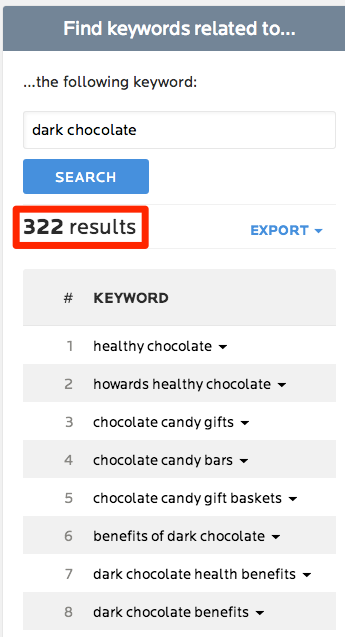
Head to the Related keywords tool (just on the left of the page) , and enter a word relevant to what you're researching. Wordtracker searches websites that score well on search engines for the search 'chocolate' and extracts the phrases that those sites use. You'll find relevant keywords such as dark chocolate candy, dark baking chocolate, candy gifts, and so on.
You’ll find lots of keywords that you might not have considered before - lots of terms that your potential site visitors are using in their searches.
Read through the list of related keywords and pick the ones that you feel are relevant to your business - either products or services that you provide, or relevant topics that you can produce helpful good quality content around. Again, you can use the 'Search' or 'Search & save' to build lists from the Related tool results.
Your input and insight are required: Wordtracker is not a machine that churns out a list of keywords that will automatically bring you traffic and success. If that was so, everybody would get the same results. Rather, Wordtracker is a tool that allows you to find your best keywords.

Keyword research doesn't stop

The average person will do their keyword research on a single basic term and stop. And, the average person will do their keyword research once - perhaps when they are building their website - and then forget about it.
But that is the way to get average results. Effective keyword research is an ongoing process and to get outstanding results you must work at it regularly.
If you want to be a successful keyword researcher:
1. Regularly check your keyword counts using Wordtracker's Keywords tool. Counts can go up and down over time, and keywords can become more (or less) popular.
2. Continue to add keywords to your Projects. The more money-making keywords there are on your site, the more profitable your online business is likely to be.
3. Monitor how well their keywords do. Performance will always come from a mixture of the following types of keywords:
  • Keywords that bring good traffic and good conversions (these are the words people use when they are in buying mode.)
  • Keywords that bring good traffic but poor conversions (these are the words people use when they are in research mode.)
  • Keywords that bring low traffic but great conversions (these are the words that represent buying behavior in niche markets.)
Next we'll look at how you can pick the most competitive keywords from your research and how you can use those keywords in your website copy (the text that appears on your web pages).

How search engines work ?!

 How search engines work ?!
 
Understanding how search engines work is the first step to being found by your customers through organic searches.

Key Points

  • The spider software crawls the web looking for new pages to collect and add to the search engine indices.
  • The index software catches everything the Spider can throw at it.
One of the most frequently asked questions from website owners is, "Why can't my site be found on Google?" They know it's important to appear in search engine results but they just don't know why it doesn't happen to them. Ken McGaffin gives this introduction to search engines in Part 1 of Wordtracker's Keyword Basics series
Website owners may well be in awe of the 'black arts' of search engine optimization or puzzled by the complexity of it all. If they're unlucky they will have paid out money to some snake oil salesman guaranteeing to get them to the top of Google's search rankings in 48 hours - and been sorely disappointed with the lack of traffic that results.


Most search engine optimizers are highly ethical, professional people but they do tend to keep their cards close to their chest.

The big secret is there is no big secret

How do search engines work?

It's true: the 'big secret' of search engine optimization is that there is no big secret.
It is all about understanding what is going on behind the scenes, followed by the hard work and attention to detail that are common to many business activities.

Inside the guts of a search engine

Let's take a simple look at a search engine. There are three pieces of software that together make up a search engine: the spider software, the index software and the query software.
If you understand what these three do, then you have the foundation for getting your website to the top of the search engines.
Here's what the three types of software do:
The spider software 'crawls the web looking for new pages to collect and add to the search engine indices'.
This is a metaphor. In reality, the spider doesn't do any 'crawling' and doesn't 'visit' any web pages. It requests pages from a website in the same way as Microsoft Explorer, or Firefox or whichever browser you use requests pages to display on your screen.
The difference is that the spider doesn't collect images or formatting - it is only interested in text and links AND the URL, (for example, http://www.Unique-Resource-Locator.html) from which they come. it doesn't display anything and it gets as much information as it can is the shortest time possible.
Since the spider doesn't collect images, it doesn't take notice of Flash intros or colorful pictures. So, make sure your images, logo or videos are identified by a text 'alt tag,' or the spider will ignore them and they will not have value in the search engines.
The index software catches everything the spider can throw at it (yes, that's another metaphor). The index makes sense of the mass of text, links and URLs using what is called an algorithm - a complex mathematical formula that indexes the words, the pairs of words and so on.
Essentially, an algorithm analyzes the pages and links for word combinations to figure out what the web pages are all about - in other words, what topics are being covered. Then, scores are assigned that allow the search engine to measure how relevant or important the web pages (and URLs) might be to the person who is searching. While each of the major search engines (like Google, Yahoo or Bing) has their own secret algorithm for scoring, they are all using the information a spider collects.
And of course the index software records all of this information and makes it available.
The spider takes the information it has gathered about a web page and sends it to the index software where it is analyzed and stored.
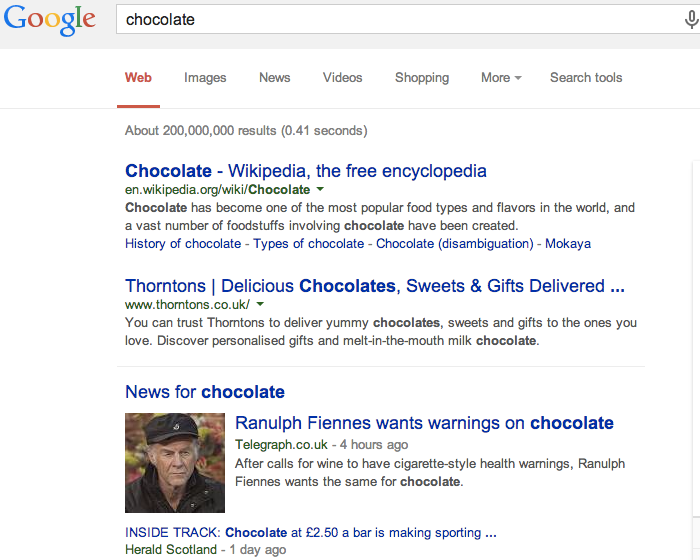
When someone types chocolate into the query box on a search engine page (such as Google), then it's time for the query software to go to work.
The query software is what you see when you go to a search engine - it is the front end of what everybody thinks of as a search engine. It may look simple but the query software presents the results of all the quite remarkable spider and index software that works away invisibly on our behalf.
So, when you type in your search words and hit search, then the search engine will try to match your words with the best, most relevant web pages it can find by 'searching the web'.
But this too is a metaphor and perhaps the most important one.
The query software doesn't actually search the web - instead, it checks through all the records that have been created by its own index software. And those records are made possible by the text, links and URL material the spider software collects.

What you need to understand about search engines

That is it. What you need to understand is that the search engine has done all the hard work of collecting, analyzing and indexing web pages, BUT it only makes that information available when someone does a search by entering words in the search query box and hitting the return key.
The words people use - what words they type into the query box - when they search will therefore determine the results the search engine presents. So search engine optimizers want to know the words people use when they search - we call them keywords (that might sound fancy but keywords are only 'the words people use when they search'.)
And that's what Wordtracker provides - information about the words people use when they do a search. Use keywords in the text (called 'website copy') on your web pages and you will prosper: ignore them and your online business will surely perish.

Get a free 7-day trial

A subscription to Wordtracker's premium Keywords tool will help you to:
  • Generate thousands of relevant keywords to improve your organic and PPC search campaigns.
  • Optimize your website content by using the most popular keywords for your product and services.
  • Research online markets, find niche opportunities and exploit them before your competitors.
Take a free 7-day trial of Wordtracker’s Keywords tool 

WordPress SEO: How to Interlink Your Articles the Right Way

WordPress SEO: How to Interlink Your Articles the Right Way


WordPress SEO
WordPress SEO isn’t hard…
You just need to know what to do, where to do it, and how to implement it.
That’s why DIYthemes is launching this new SEO training series.
It’s called WordPress SEO for Everybody, and you’ll learn the latest SEO strategies that work.
Now let’s proceed to the first tip.

How to Interlink Your WordPress Blog Posts the Right Way

If you want your WordPress site to rank higher in search engines, in addition to tweaking your WordPress category pages, you need to link your new articles to your older, relevant articles.
But how should you link them? What posts should you link? What anchor text should you use?
Well, first, you can link your articles using anchor text you’d like to rank for.
However, that won’t propel you to top rankings by itself, and that’s where this quick tip comes into play.
Instead of focusing on what you want to rank for, look at what you’re already ranking for.
I’ll explain.
Take a second, and load up your Google Analytics.
Look at your current keywords, and see the articles that already rank in search engines.
If you’re not ranking #1 for any of the keywords that send you traffic, make sure you link those articles from your new stuff.
It’s easier to improve your existing rankings, than it is to rank for something completely new.

Before You Interlink, Consider These Two SEO Nuances:

What do I mean by nuances?
They’re not secrets, they’re just the way many top SEOs believe search engines work.
As you know, search engine optimization is often an inexact Science, despite there being several search engine optimization best practices.
That being said, here are the two tips:

1. Links higher in the HTML pass more search juice

Here’s the deal:
When you link articles higher in the HTML—towards the beginning of your content—it passes more juice.
It makes sense, too.
If a link is above-the-fold, it’s probably more important than a link buried in the footer.
So, when interlinking pages that are important, make sure you keep it as close to the fold as possible.

2. Search engines only follow, and use the first instance of a link

Interesting, right?
If you link the same older, relevant article from within the same new post, search engines supposedly only use the first instance of a link in their algorithm.
Again, it makes sense.
Why would search engines give preferential treatment to someone who often links only one article, with varying anchor text?
Yes, you can do that when it’s coming from different new posts, but from within the same post?
It sounds awfully like spamming, and it’s no wonder it doesn’t work.
So, the key takeaway is, only interlink the same page ONE time.

What Next?

If you absolutely loved this article, make sure you sign up for free email updates to ensure you don’t miss out on the upcoming updates. Just enter your email in the blue box below, and you’ll be set.

WordPress SEO (Part 1): How to Optimize Your Blog Posts


 WordPress SEO

     Getting high search engine rankings for your blog takes work. A lot of work. While we all know the benefits of SEO, sometimes there just isn’t enough time to focus on both SEO and developing a quality product or business.
What can you do? You could hire a SEO consulting firm like Outspoken Media, but if you lack a budget, this article is perfect for you.
Everyone knows that creating fresh, engaging content helps build a loyal following and attract links. However, if you’re looking to improve your SEO with no budget, you can tweak your existing articles to prime it for high search engine rankings.
Now I’m not saying that your website will shoot up into Google’s top 3. I’m also not going to tell you to stuff as many keywords into your post as possible. If I did, that would be cheesy and I would be lying.
Instead, I will say this: if you focus on these 7 key areas of on-page SEO, you can improve your search engine rankings. How do I know this? Because it worked for me.

Conduct Keyword Research

You could try and guess what what people type when they use a search engine, but with free Keyword Research tools available, it’s wasted effort.
What are some of the best, free keyword tools? You could use the Google tool, or one that I like is Wordtracker. In addition, you can use this tool from Google to research trends in search phrases.
If you’re looking for a premium keyword research tool, look no further than SEObook.com, SEOmoz.org, or Raven Tools.

Focus on Low-Competition Keyphrases

Don’t waste your time going after highly competitive keywords with on-site optimization because you won’t be able to nab them.
So, how do you know if a keyword or keyphrase is competitive?
Take one of the phrases you found while conducting keyword research, type it into Google search using quotations (ex. “how to install Thesis Theme Framework”), and then look at the number that appears below the search box.
search result exampleFigure 1: See the 12,900 results below the Search Box? That’s the number you’re looking for.
If the number is large (over 75,000), I’d avoid it because it’s highly competitive. If it’s small, I’d focus on it because it should be much easier to score a top ranking.
Note, just because a keyword or phrase isn’t competitive doesn’t mean it won’t send traffic. And if it doesn’t send much traffic, that doesn’t matter either because the traffic it does send is highly targeted. For example, I once optimized a post that landed the #1 position in Google and it helped me make a $1500 sale.

Choose One Keyword or Phrase, and then Write or Tweak Your Article

While you want a keyphrase with little competition, you’ll also want it to have some search traffic (greater than zero). Then, either write a post that targets that keyphrase or go back through some of your older articles and tweak them for a specific phrase.
I’m not saying that you should let that keyphrases dictate what you write about. Instead, find a phrase that relates to your topic, and craft a helpful article around it. Remember, quality content matters. The higher the quality, the better chance it will garner links and then rank in search engines.
For example, if you run a blog about Kangaroos, and one of your researched keyphrases is “what do kangaroos eat”, then you might want to write a blog post about that.

Use Your Keyphrase In Your Post Title and Title Tags

Yep, simple as that. Use the keyphrase in the title of your post and in your title tags.

Repeat the Keyphrase in Your Article.

You want to build a loyal following, so don’t go crazy with this. Instead, what I mean is, if you want to rank for your keyphrase, you must use it. Avoid creating nicknames or trying to be clever. In the end, clear and concise wins. As a rule of thumb, try to include your keyphrase early on in your article or in a H2 tag. While this may have little impact on your rankings, it will help show your readers that they’re reading the right piece of content.

Use the Keyphrase in your Meta Description tags

Using keywords in your meta description tags does not help you rank higher. However, when you include them, when people search on Google for a specific keyword, Google bolds the keyphrase in the search results. So, while it may not help you rank higher, it will encourage people to click on your search results.

Find Images Related to Your Keyphrase

Think about it. If you were looking for information on Kangaroos, when you visited a website, would it make sense to have a picture of a Kanagaroo on it? Absolutely.
So, when you publish your articles, ensure that you find related images and use your keyphrase in the alt description of your image. This is beneficial for two reasons: first, it helps search engines see that you’re trying to create a complete piece of content, and second, it’s great for accessibility.

Other SEO Factors

There are, of course, other factors that influence your search engine rankings that I don’t talk about here. However, if you want to focus on building your business and creating great content, these 7 areas can help kick-start your SEO without becoming a full-time job. If you have any other quick hints that you think people will find useful, feel free to leave a comment.

Top 21 SEO Tips and Tricks

Top 21 SEO Tips and Tricks

Google says on the record, “Don’t write for Search Engines, Write for your readers/audience/users.” While this may sound ridiculous, there are plenty of reasons to follow the advice. More often, newbie falls in the trap and often gets confused where to start from. Don’t sound to be too harsh, but do not always listen to almighty Google.
We (bloggers & web entrepreneurs) are mere small creatures and we must write for our readers/users while keeping search engine behavior at the corner of our brain! Producing great content that reader’s love is something not everyone’s cup of team. So how would you start your venture as an expert ? What are the best SEO practices that you should follow? Without further ado, let me present you top 20 SEO Tips.
Excellent SEO Tips To Follow
I have used an adjective here – Special. These tips are special not because they are something that you have never heard of, but they are special as you have not understood these basic ones quite effectively!
seo tips and tricks

Keyword Analysis inclusive of Competition Analysis

1. Determine Strategy for Keywords

This must be your first and foremost step. You should be clear with your goals that what keywords you want to play around with. This depends on what you want to gain by your online presence and venture. The question in the previous sentence can be answered with information regarding your target audience.
It may look like a flow chart or catch 22 for you, don’t worry, you are right and it is so. We have solutions for it. You can use certain keyword tools like www.keywordspy.com, www.spyfu.com, www.ispionage.com and www.compete.com. In order to get complete market scenario you must look at your competitor’s website. You can enter that website’s URL to any of the mentioned tools and get an estimation of competition.

2. List The Potential Keywords

You have now, different results from different tools as all of them use different methodology. You can collaborate all the results depending on your common analytical sense and list out 50-100 potential keywords. Create an MS Excel sheet for these Keywords.

3. Check Competition of Keywords

Keyword competition is something most newbies/expert ignores. While sorting out bunch of keywords from Google adword keywords tool is the first step to follow, people often forget that the checking Keyword competition is equally important. There are plenty of tools available out there, but we recommend to try out tools like Traffictravis first.
Later, you can go for the premium tools like SEOMoz keyword difficulty and SERPIQ keyword competition analysis tool. Both the tools delivers the great result and cut down considerable work required in doing competition analysis as well as keyword competition analysis.

On Page SEO Tips

4. HTML

Use a content management service such as WordPress, Blogger or Drupal and optimize your HTML tags with the keywords. Make sure you also maintain text to HTML ratio. Always try to keep the ratio high so that Google can understand your content better.

5. Title

Keep the character count under 70 and preferably under 66. Use various plugins available for various content management platforms for SEO. The WordPress beginners should start with WordPress SEO plugin by Yoast to make on page SEO as much better as they can. There are also many third-party paid options available in the market, but we do not recommend using them.

6. Meta Tags & Description

Your keyword must be there in your Meta tag and description. Your meta description must be in the vicinity of 157 characters. This is most important as Search Engines read meta description for understanding the post content.

7. URL and/or Permalinks

Your page URL must contain your key word or keyword phrase. If it is a phrase, words must be separated by hyphens. Use some plugins to remove stop words from the URL/permalinks. It’s always good to minimize the use of STOP word in the permalink

8. First Paragraph

While this is not necessary a big factor in ranking, try to include important keyword in first paragraph, so Google can clearly understand what the topic is about. While there is no hard and fast rule, make sure you include primary keyword within first few words of the article.

9. Content Length

As per Guidelines provide by Google, the length of your content must be more than 300 words. We advise you to write content with word count above 500 words. (It will help to protect you from “Animal Hit”). However, we recommend to go over 600-700 mark whenever possible. Instead of writing a simple post without proper information, you should focus your energy to provide quality content with necessary bullet point and images to back-up what you say.

10. Content Quality

Your content must be unique. Thinly copied contents are also getting Panda Hit nowadays so stay away from copy and plagiarism. Make sure you follow proper internal linking strategy without over optimizing anchor text.

11. Keyword Density

Keyword density must be between 2-4%. It means your keyword must not be repeated more than twice or thrice in each 100 words block so if your are writing a 500 words post your keyword count must not exceed 10-15 repetitions. If it does, then Google will count it as over optimization.

12. Image Optimization

Optimize Image ALT tag with your keyword. It is always a good idea to save the image name with the keyword and upload them on the server with the same name. Also attach necessary ALT tag to the image, so Google can understand what the image depicts. Remember, Google is blind, and you need to supply information to Google to understand the image. Moreover, try to provide a wrap up text to explain what the image is all about. This will increase the relevancy as well.

Sitemap

13. Sitemap Submission

Submit your site to the major search engines. Create an XML site map and make sure the search engines can find your site map. Use Google’s webmaster’s tools to verify your sitemap is being read correctly: http://www.google.com/webmasters/

14. HTML Sitemap

Creating an HTML sitemap is an essential part of your SEO endeavors. This confirms you that search engine crawlers are crawling the site properly.

Back-End

15. Avoid DHTML and Excessive HTML

Search Engines can’t read DHTML menus quite easily, so avoid them in your menu. Also, try to maintain HTML to text ratio. Having too many HTML makes the ratio high which is often undesired. Make sure you provided meaningful insight in each and every paragraph and/or article by providing more text.

16. Avoid Major Content in PDF or Flash

Publish your content in HTML format instead of Adobe PDF and Flash. Valuable content that is locked in these formats cannot be easily crawled and indexed.

17. Robots.txt

Make sure your robots.txt file is configured correctly to include and exclude the appropriate directories and files on your website. This file instructs search engines that which portion of your site is not accessible to search engines. Often people misunderstands this concepts which results in duplicate content or the description is unavailable due to robots.txt configuration.

Off Page Optimization

18. Use Social Media Effectively

Market your content on various social networks and media. Try various titles and descriptions that can engage users with your online venture. Initially, target twitter, Facebook, Google+, Stumble Upon, LinkedIn and Reddit. Google is now giving more importance to social media signals to rank website. Now is the time to utilize social media platform and turn the tale in your favor.

19. Generate Quality Backlinks

There are various techniques to generate backlinks. Guest post on other high authority site from same niche, Commenting on the posts related to your site content, Forum Posting and many more techniques are there which should be used moderetly to gain more trust. Well, backlink is itself a big chapter and can cover tons of pages, but we do not want to go that route for the moment.
Please note that Google introduced an update called Penguin to penalize the overly optimized sites, which means that those sites which are having spam backlinks and using black hat backlink techniques.  I will explain you in detail  how it will identify the spammers, see if there is a site on Diabetes (Health Niche) and the site site owner purchased a bulk of backlinks for the anchor text “diabetes symptoms in children” to rank for that keyword.
This can get a red flag and can get  penalty because if that is a genuine quality site/article then there should be lot of variations in the anchor test linking to that particular page, because it is a common sense that not everybody in the world will link to the exact anchor text right ?  … Yes, that is not at all possible :) because they may link to that via various anchor texts like
  • diabetes signs and symptoms in children
  • diabetes in children
  • children and diabetes : signs and symptoms
  • what are the symptoms in children with type 2 diabetes
  • type 1 diabetes symptoms in children and adults


Analysis

20. Use Google Analytics

Install Google Analytics on your website.( http://www.google.com/analytics/ )If you’ve already done this, use the data from: Traffic Sources > Keywords to find additional keywords you may want to optimize.

21. Keyword tracking

Tracking your major campaign and keywords in the Google will give you a clear information about your efforts. It’s therefore very necessary to keep track of all your keyword ranking. For this purpose, you can use free and paid tools available online. Even, you can manually track the keyword in the Google. We recommend to use “whatsmyserp.com” or similar service to check your keyword ranking.
Hopefully, the above SEO tips will help you to start your new venture or website. Make sure you follow each and every one of them closely.

Visual Basic 6 and Excel VBA Made Easy Books

Visual Basic 6 and Excel VBA Made Easy Books


VISUAL BASIC 6 MADE EASY is an eBookwritten to compliment Online Visual Basic 6 Tutorial so that you can read it offline in your leisure time. It has more contents than the free online tutorial. You can use this book as a textbook for the tutorial. For your information, the print version of this book is published and marketed by Amazon.com.

By reading this book ,you can:
  1. Understand the basic concepts of Visual Basic 6 programming
  2. Create your own VB6 programs right from the beginning
  3. Get programming ideas from many interesting sample programs. The sample programs include star war, snakes and ladders game, reversi, home loan calculator, BMI calculator, library system, calculator and more.
  4. Modify the codes easily to suit your needs.


This book was written using simple English without technical jargons so that you can understand programming concepts even if you have no technical background.

You can also use the book in many ways, such as:
  • As a source of reference for your programming hobby.
  • As a source of reference for your school or college projects. Please feel free to use the materials in my book for your assignments.
  • As teaching material if you are a school teacher or college lecturer who teaches computer programming. (The book was used as a recommended textbook for the first year computer science students of the University of Wesleyan of USA by Professor Dr. Michael D. Rice )
  • Teach your kids how to program in VB6 if you are a parent.


EXCEL VBA MADE EASY is an eBookwritten to compliment Online Excel VBA Tutorial so that you can read it offline in your leisure time. You can use this book as a textbook for the tutorial. For your information, the print version of this book is published and marketed by Amazon.com. Excel VBA tutorial.

By reading this book ,you can:

  1. Understand the basic concepts of Excel VBA programming
  2. Create your own Excel VBA programs right from the beginning
  3. Get programming ideas from many interesting sample programs.
  4. Modify the codes easily to suit your needs.


This book was written using simple English without technical jargons so that you can understand programming concepts even if you have no technical background.

You can also use the book in many ways, such as:
  • As a source of reference for your programming hobby.
  • As a source of reference for your school or college projects. Please feel free to use the materials in my book for your assignments.
  • As teaching material if you are a school teacher or college lecturer who teaches computer programming.
  • Teach your kids how to program in Excel VBA if you are a parent.

How to success with your Affiliate program !!!

First time Affiliate?  Follow these 6 steps to success…

You got your Affiliate links and now what?  I’m assuming up to this point this may be your first time promoting an Affiliate Program and you understand basic HTML for installing your links.  Use the guide below to help you start making Money with your new links. Or, if you’re considering Affiliate Marketing as a source for monetizing your blog the below steps let ya know what you’re getting into.  Buckle your seat belts!  (believe it or not, the ride can be more fun than you think!)

1.Where your links should direct.

The homepage is simple but for more targeted content and banners, you should ask your program manager to link to specific product pages or search results relevant to your site.  Doing so may mean a greater chance of a conversion. $$$

2.How to promote your links.

The most popular methods are blogs, websites, and newsletters.  Of course, there are other clever ways of promotion.  Newer technologies allow for social media and apps.

3. Develop the content.


Depending on the link you’re promoting, you’ll want to be as relevant as possible. For example, affiliate links for pet food products typically do well on sites that talk about pets. There are different ways of developing your content depending on what you wish to promote.  However, that is deserving of  a post all its own.  (Check out this blast from the past)

4. Get traffic to your site.

The more eyeballs on your site the greater the chance someone to click your links.  There are lots of different methods but here are some of the most popular…..
Social Media – do you blog?  If so tweet out your articles with a relevant account. ?  Start a Facebook fan page for your website.  Pinterest?  Make sure your pins are relevant to your content and forward back to your website.
Comment and Engage.  Get visitors by commenting in forums, commenting on others blogs, tweeting to engage your followers, etc.By being vocal you are letting others know you exist.
Ever try Google AdWords?  Bidding on Keywords can be a way to ensure that when people search for your chosen keywords they are provided with a display and option to click to your site.  Be careful though!  Many Affiliate Programs will list restrictions on this technique in their Terms of Service.  Disobeying could get your account blocked. Ruh-roh!
SEO (search engine optimization). Develop your content in a way that allows search engines to find you and rank your site depending on your relevancy.  Lots of companies pay big bucks to get trained or have someone perform this service for them.

5. Check your stats.

Keep tabs on traffic you are sending to affiliate offers and your conversions.  Tweak your site or link placement to try to achieve the highest click through for maximum conversion possible.

6. Receive your commissions!

This is the fun part!  Make sure to always have up to date payment information for your Affiliate Program Manager to send prompt payment.
Not so scary huh?!  If you’re new to the Affiliate Marketing, I suggest finding Affiliate Programs that provide opportunities for you to promote what you already love.  If you dig what your web site or blog is about your more apt to keep plugging away until you receive commissions.  Hang in there!  It may take at least 60 days for your commissions to arrive. Celebrate that first payment! Woot!
Got an Affiliate Marketing question?  Ask away in the comments below.

Truecaller – Caller ID & Block Premium Pro v5.10 apk


[​IMG]
[​IMG]
[​IMG]
[​IMG]
Caller ID & Block Premium Pro v5.01 apk
Take the Right Call with Truecaller
The easiest way to search contact numbers, block spam and identify incoming calls on your mobile phone so that you always have access to the right information, people and businesses you need.
• Search for any number whether it’s local or across the world
• Know who’s calling you even if you don’t have their number in your address book
• Block numbers from spam callers and telemarketers
• Tweet and Follow a person on Twitter directly from Truecaller
• Yelp integration for faster business lookup results
• Keeps your phonebook clean, organized and up-to-date with contacts’ profile photos from social networks
• + more features to make contact management run smoothly[plinker count=3 heading=”3 More you can choose”] [plinker]
Over 85 million people around the world use Truecaller to help manage their contacts and calls!
Truecaller NEVER uploads your phonebook to make it searchable or public. 3G or WIFI is required for Truecaller Caller ID to work. Operator charges may apply.
* The block SMS feature is currently not supported for devices with Android 4.4 (KitKat).
If you have any feedback or questions, 

Download : http://www.gulfup.com/?vHWOXg


Top List Free Best SEO Tools

Top List Free SEO Tools


Completely free tools and tools with both free and paid options. Enjoy!


Search engine optimization (SEO) is the process of affecting the visibility of a website or a web page in a search engine’s “natural” or un-paid (“organic”) search results. In general, the earlier (or higher ranked on the search results page), and more frequently a site appears in the search results list, the more visitors it will receive from the search engine’s users. SEO may target different kinds of search, including image search, local search, video search, academic search, news search and industry-specific vertical search engines.

As an Internet marketing strategy, SEO considers how search engines work, what people search for, the actual search terms or keywords typed into search engines and which search engines are preferred by their targeted audience. Optimizing a website may involve editing its content, HTML and associated coding to both increase its relevance to specific keywords and to remove barriers to the indexing activities of search engines. Promoting a site to increase the number of backlinks, or inbound links, is another SEO tactic.

(copy the links below, add http:// if necessary  and paste to your browser)


Google Keyword Planner
adwords.google.com/keywordplanner
Keyword Research
The tool to replace Google’s popular keyword tool has been derided by some, but still offers data not available anywhere else.

Google Analytics
google.com/analytics/
Analytics
The most popular of all the analytics tools available, Google Analytics continually innovates and sets the standard.

Google Analytics API
support.google.com/analytics/answer/1008004?hl=en&ref_topic=1008008
API, Analytics
The Google Analytics API is great for building custom reports and tools, and also for pulling data straight into Excel or Google Docs.

Google Map Maker
google.com/mapmaker
Local
Among other things, Google Map Maker allows you to contribute to public map information, which may be shared and incorporated into Google Maps.

Google PageSpeed Insights
developers.google.com/speed/pagespeed/insights
Speed
Tools, data, and insights to improve your page speed. Page speed is correlated with better rankings and user engagement, so this matters.

Google Public Data
google.com/publicdata/directory
Content
Drawing on vast public databases, Google public data offers a great starting point for content research, infographics, and more.

Google SERP Snippet Optimization Tool
seomofo.com/snippet-optimizer.html
Technical SEO, CRO
That SEO Mofo! Use this tool to see how your snippet may appear in Google’s search results. Add structured data, review stars, and more.

Google Structured Data Testing Tool
google.com/webmasters/tools/richsnippets
Structured Data, Technical SEO
If you use Schema.org microformats or any other type of structured data, this tool will verify your markup.

Google Trends
google.com/trends/
Keyword Research
See what’s trending in Google search results and view keyword search popularity over time. A must for trends.

Google Webmaster
google.com/webmasters/
Tools Suite, Diagnostic
The interface recently received an overhaul, and Google Webmaster remains a must-have resource of diagnostic and health tools for site owners.

Bing Webmaster Tools
bing.com/toolbox/webmaster
Tools Suite, Diagnostic
Similar in function to Google Webmaster Tools, Bing offers a suite of interesting research tools and resources for webmasters.


Domain Hunter Plus
domainhunterplus.com/
Link Building
This magic extension for Chrome not only helps you find important broken links, but also tells you if the links point to an available domain.

Easel.ly
easel.ly/
Infographics
Free tools for creating and sharing inforgraphics. The templates allow anyone to create a professional-looking graphic.

Email Format
email-format.com/
Email, Productivity
Email Format helps you find the proper structure for thousands of companies and organizations across the web.

FindPeopleonPlus
findpeopleonplus.com/
Social
The ultimate Google+ directory that’s great for research, outreach, and link building. Sort by keywords, profession, country, and more.

Frobee Robots.txt Checker
frobee.com/robots-txt-check
Robots.txt, Technical SEO
Many robots.txt files contain hidden errors not easily visible to humans. Run your file through this tool and you never know what you’ll discover.

GetListed
getlisted.org/
Local, Moz
This awesome local SEO tool scores your local SEO visibility and gives you actionable next steps to raise your score.


IFTTT
ifttt.com/
Productivity
IFTTT stands for IF This, Then That. The tool allows you to create automatic triggers between various apps, like Gmail and Twitter.

Infogr.am
infogr.am/
Infographics
A great free Infographics resource that allows you to easily create graphics and data visualizations.

Internet Marketing Ninjas SEO Tools
internetmarketingninjas.com/tools/
Tools Suite
The Ninjas are some of the best SEOs and online marketers out there, and they’ve put some of their best tools online for free.

Linkstant
linkstant.com/
Link Building
This nifty analytics tool alerts you anytime someone links to your website. Great for outreach and intelligence gathering.

Linksy.me Email Guesser
linksy.me/find-email
Email, Link Building
Need to send an email, but you don’t have the recipient’s address? Type in what you know and this nifty tool will help you figure it out.

MailTester.com
mailtester.com/
Email
Need to send an email to an untested address, but you don’t want to spam them? Check it first with this mail tester to verify.

MozCast
mozcast.com/
SERP Tracking, Moz
Want to know if Google is testing its algorithm this week? MozCast gives you a daily weather report to track changes in the SERPs.

Anchor Text Over Optimization Tool
removeem.com/ratios.php
Link Research, Technical SEO
Worried about Google’s Penguin algorithm hitting you for over-optimized anchor text? Simply type in your URL for a full report of which links might raise flags.

Bitly
bitly.com/
Social, Analytics
Most people use Bitly for URL shortening, but the real power of this platform comes from its analytics.

Boomerang
boomeranggmail.com/
Email, Productivity
Boomerang lets you follow up on emails, even when you forget. Great for link building or any time you send a lot of emails.

Buffer
bufferapp.com/
Social
Optimize your online social media sharing. Buffer allows you to share with your audience at the optimal times for greater visibility.

BuiltWith
builtwith.com/
Competitive Intelligence
Use BuiltWith to discover what technology nearly any website was, well, built with. Great for competitive intelligence as well.

Buzzstream Tools Suite
tools.buzzstream.com/link-building
Link Building, Tools Suite, Email
Most people know Buzzstream as an outreach platform, but they also offer a number of free link-building tools. This company gets it.

Caption Tube
captiontube.appspot.com/
Video
Free and easy resource used to create captions for YouTube. Helps with usability and offers viewers a readable transcript.

CircleCount
circlecount.com/
Social, Analytics
Google+ analytics ramped up. Free resource to track your followers and analyze your shares. See how many followers you’ve gained over time.

Content Strategy Generator Tool
seogadget.com/content-strategy-generator-tool-v2-update/
Content
This tool from SEOgadget helps you plan your content strategy intelligently, using keyword research and estimating your audience size.

Convert Word Documents to Clean HTML
word2cleanhtml.com/
Content, Productivity
Despite the rise of Google Docs, Word still dominates much of the world. Copying and pasting has always been a hurdle, but this tool makes it easy.

Copyscape
copyscape.com/
Content
Copyscape serves both as a plagiarism checker and a duplicate-content checker. Great to use if your content has been distributed across the web.

MyBlogGuest
myblogguest.com/
Link Building, Content
Guest blogging is still alive and thriving. MyBlogGuest helps you find the good opportunities out there.

Panguin Tool
barracuda-digital.co.uk/panguin-tool/
Analytics
This awesome tool connects with your Google Analytics account to help you see if and when you’ve been hit by Google Algorithm updates.

Pingdom
tools.pingdom.com/fpt/
Speed
Pingdom offers an entire suite of speed tools to help analyze page load, DNS issues, and connectivity.

Piwik
piwik.org/
Analytics
Piwik is a lightweight web analytics solution, and a great alternative to Google Analytics.

Rank Checker for Firefox
tools.seobook.com/firefox/rank-checker/
Rank Tracking
This light and easy desktop tool checks rankings with the click of a button. Quick, easy and free.

Rapportive
rapportive.com/
Email, Link Building, Productivity
Rapportive works with your Gmail inbox to give you near-instant rich contact information for almost everyone you want to reach. A must-have for marketers.

Remove Duplicate Items
ontolo.com/tools-remove-duplicates
Productivity
Ontolo offers a suite of link building software and a few helpful productivity tools for link builders. The remove duplicates tool solves a common problem.

Robots.txt Checker
tool.motoricerca.info/robots-checker.phtml
Robots.txt, Technical SEO
Use robots best practices and discover hidden errors in your robots.txt files that may cause search engine crawling problems.

Schema Creator
schema-creator.org/
Structured Data, Technical SEO
Everyone loves using Schema.org, but the microformats are difficult to write by hand. This generator from the folks at Raven simplifies the task.

Scraper for Chrome
chrome.google.com/webstore/detail/scraper/
Productivity
If you’ve never scraped a webpage, you’re missing out. Scraper for Chrome puts the power of simple web scraping in your hands without the need for code.

Seer Toolbox
seerinteractive.com/seo-toolbox/
Tools Suite, Analytics, Link Research
SEER opened up its internal toolbox for everyone in the world to use. These are the same tools used in-house at SEER, and they rock.

SEO Toolbar
tools.seobook.com/seo-toolbar/
Tools Suite, Toolbar, Technical SEO
On of the most popular tools available, The SEO Toolbar puts a ton of information at your fingertips including backlinks and competitive research.

SEO Tools for Excel
nielsbosma.se/projects/seotools/
Tools Suite, Analytics, Social
You don’t need to be an Excel ninja to use Niels Bosma’s SEO Tools for Excel. This plugin does so many things many SEOs won’t work without it.

SEOgadget Links API
seogadget.com/api/
API, Link Research
The SEOgadget Links API lets you easily gather not only backlink data but contact information as well. A huge time saver.

SEOgadget Tools
seogadget.com/tools/
Tools Suite
This suite of tools from the Gadget lab includes several Excel plugins, a content strategy generator, and more.

SEOQuake
seoquake.com/
Toolbar, Tools Suite, Technical SEO
More raw data than any other SEO toolbar out there.

SharedCount
sharedcount.com/
Social, Analytics
Want to know how any piece of content was shared socially across the major services? This is the tool to use.

SharedCount API
sharedcount.com/documentation.php
API, Social
Harnessing the combined statistics of Google+, Twitter, Facebook, and more, the SharedCount API puts a ton of social data at your fingertips.

Similar Page Checker
webconfs.com/similar-page-checker.php
Content, Technical SEO
Use this tool to check for duplicate content issues. The Similar Page Checker will give you a score of how closely the HTML of two pages resemble each other.

Sitemap Generators
code.google.com/p/sitemap-generators/wiki/SitemapGenerators
Sitemaps
Google offers a slew of free, top-notch sitemap generators. Most of these live on your server and generate new sitemaps automatically.

Social Authority API
followerwonk.com/social-authority
API, Social
How much reach and social authority do your followers have? How about the people you’re trying to connect with? The free Social Authority API will tell you.

Social Crawlytics
socialcrawlytics.com/
Social, Analytics
Social Crawlytics allows you to conduct competitive research by showing you your competitors’ most-shared content. Lots of other features as well.

Social Mention
socialmention.com/
Social
Social mention offers real-time social media search and analysis. Enter a search term and see who’s sharing what, right now.

Text Cleaner
textcleanr.com/
Content
Some of the best tools solve the simplest problems. Text cleaner cleans up all kinds of text formatting when copying and pasting between aplications.

Ubersuggest
ubersuggest.org/
Keyword Research
Every SEO loves Ubersuggest for its ease of use and wealth of keyword research ideas. Utilizing the power of Google Suggest, it returns hundreds of potential results.

URI Valet
urivalet.com/
Technical SEO
A great tool for digging into server headers, canonical information, analyzing redirect problems and more.

Virante SEO Tools
virante.org/seo-tools
Tools Suite
Virant offers a number of high quality SEO tools to the public. These are often the same tools developed for the Virant team, opened up for public use.

Wayback Machine
archive.org/web/web.php
Competitive Intelligence
Want to see the history of your website or your competitor’s site? The Wayback Machine allows you to step back in time and track important changes.

WebPagetest
webpagetest.org/
Speed
Quick and easy website speed tool. Offers suggestions for improving performance.

Wordle
wordle.net/
Content
Create beautiful word clouds. Great for visualizations, graphics, and research.

Wordstream Free Keyword Tools
wordstream.com/free-keyword-tools
Keyword Research, Tools Suite
In addition to its paid offerings, Wordstream offers a suite of free keyword tools offering access to thousands of keyword suggestions.

Xenu’s Link Sleuth
home.snafu.de/tilman/xenulink.html
Diagnostic, Technical SEO
Winner of the ugliest-SEO-tool-on-the-planet award, Xenu is also one of the most useful. Crawl entire sites, find broken links, create sitemaps, and more.

XML-Sitemaps.com
xml-sitemaps.com/
Sitemaps
XML-Sitemaps offers probably the easiest sitemap creation solution anywhere. Great for smaller sites when you need a sitemap in minutes.

Yahoo Pipes
pipes.yahoo.com/pipes/
Content, Productivity
A great mashup tool that combines different feeds into content and other magical creations. Used for link building and whatever you can dream of.

Yoast WordPress SEO Plugin
yoast.com/wordpress/seo/
Technical SEO
If you could only choose one WordPress plugin for you site, the first would be from Yoast, and so would the second. This one sets the standard.

YouTube Analytics
youtube.com/analytics
Video, Analytics
Offers video-specific analytics for YouTube videos. A must-have for YouTube video publishers.
Free and Paid

Ahrefs
ahrefs.com/
Link Research, Link Building
One of the more popular link research tools, Ahrefs offers a large index and nice anchor text distribution charts. Mostly a paid tool, but they offer some free data.

Banana Tag
bananatag.com/
Email
Banana Tag allows you to track your emails after you send them. For example, check your email open rates from Gmail.

CloudFlare
cloudflare.com/
Speed
How do they make CloudFlare free? It works both as a CDN and a security service to provide your website with speed and safety.

Followerwonk
followerwonk.com/
Social, Analytics, Moz
Perhaps the coolest thing about Followerwonk is the ability to track your followers. Smart SEOs also use it for outreach and research.

Keyword Eye
keywordeye.com/
Keyword Research
Keyword eye adds a twist to keyword research by adding rich visualizations — essential when you want to move beyond keywords to valuable concepts.

KnowEm
knowem.com/
Social
KnowEm allows you to check 100’s of social profiles at once to check availability. Looking for the perfect brand name? Check KnowEm first.

Majestic SEO
majesticseo.com/
Link Research, Competitive Intelligence, Link Building
You’ve probably seen Majestic SEO link charts all over the Internet. Great crawling technology combined with several free options make for great link research.

Majestic SEO API
blog.majesticseo.com/general/majestic-seo-api-now-explained/
API, Link Research
Majestic makes much of its backlink data available for free via its API.

MozBar
moz.com/tools/seo-toolbar
Tools Suite, Toolbar, Moz
The standard SEO toolbar for legions of marketers, the MozBar allows you to perform over 50 key tasks right from your browser. Highly recommended.

Mozscape API
moz.com/products/api
API, Link Research, Moz
Companies everywhere incorporate the Mozscape API into their own products, but it’s also available to individuals, and much of the data is free.

nTopic
ntopic.org/
Content
nTopic is one of the few proven methods for giving your content a relevancy score and offering keyword suggestions to improve it.

StatCounter
statcounter.com/
Analytics
Free, quick, and lightweight analytics solution. Often used by those who want to avoid using Google Analytics for privacy reasons.

Trello
trello.com/
Productivity
Project management and tracking made simple. Used and endorsed by Moz.

Whitespark Local Citation Finder
whitespark.ca/local-citation-finder/
Local
Finding local citations is key to local SEO. Whitespark offers a number of free and paid solutions to find the local citations to rise above the competition.

Whois Lookup
whois.domaintools.com/
Competitive Intelligence
Find registration, contact, and administrative information for any domain.

Wistia
wistia.com/
Video
The king of online video, Wistia offers SEO-friendly solutions for video hosting. Both free and low-cost options available.

Open Site Explorer
opensiteexplorer.org/
Link Research, Moz, Competitive Intelligence, Link Building
When Google and Yahoo started removing backlink data from the public, Moz built Open Site Explorer to fill a huge need. See backlinks, anchor text, popularity metrics and more.

Piktochart
piktochart.com/
Infographics
A cute and easy infographic generator. No experience required.

RowFeeder
rowfeeder.com/
Social, Analytics
RowFeeder allows you to track social usernames, hashtags and keywords and load that information into Excel for easy social media monitoring.

Screaming Frog
screamingfrog.co.uk/
Diagnostic, Technical SEO
A powerful website crawling tool with a ton of features and customizations. A must-have for most serious SEOs.

Searchmetrics Visibility Charts
suite.searchmetrics.com/en/research
SERP Tracking, Competitive Intelligence
Track the search visibility of any website, in addition to tracking winners and losers in Google’s search results.

SEMrush
semrush.com/
Tools Suite, Keyword Research, Competitive Intelligence
The paid and organic keyword data offered by SEMrush is often scary good and comprehensive. Also great for researching competitors’ ads.

SERPmetrics
serpmetrics.com/flux/
SERP Tracking, Competitive Intelligence
SERPmetrics flux charts track the flux for US search results across Yahoo, Bing and Google over a 30-day period. A paid API is also available.

SimilarWeb
similarweb.com/
Competitive Intelligence
Impressive competitive intelligence across a number of online industries. Competitor website stats are hard to come by, but Similar Web does a good job.